
What Is This Thing, Exactly? Let me tell you what it is not.
It is not a “top.” The word “top” is what a consultant in a beige blazer at a mid-tier department store calls a garment before marking it up 400 percent and explaining its “capsule wardrobe synergy” to a woman who did not ask. No.
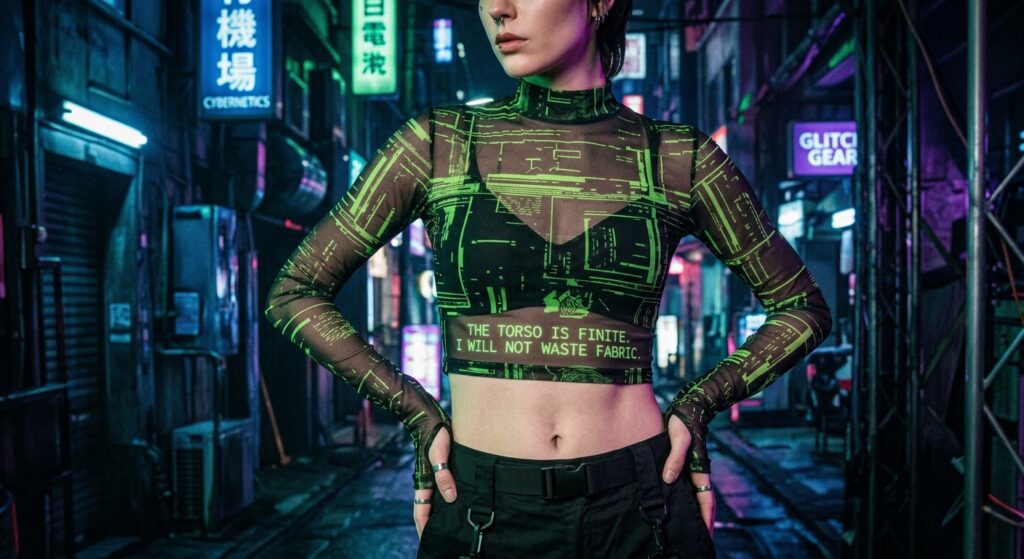
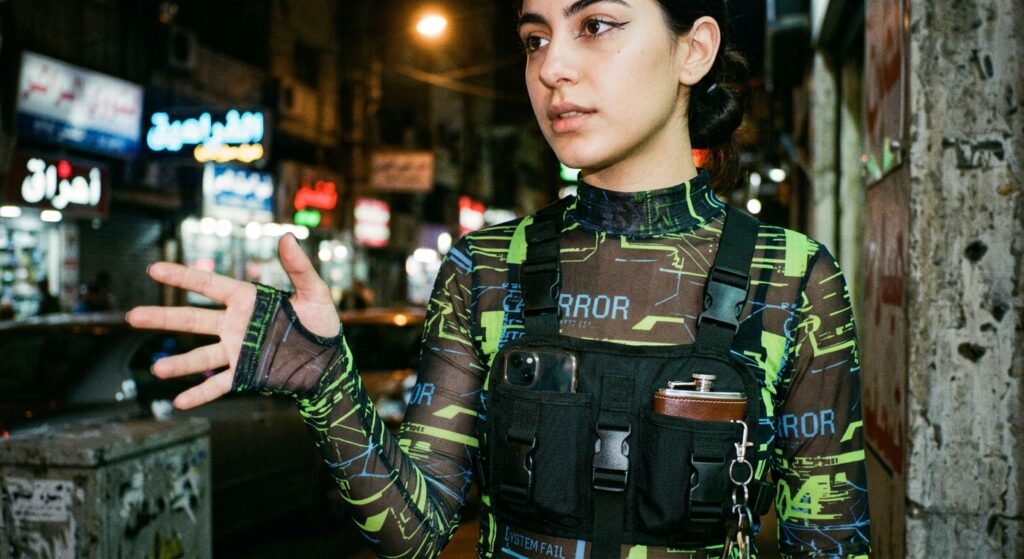
This is a Exosuit rendered in acid-soaked mesh. It is what happens when someone takes the visual language of a system crash—the horizontal tear of a corrupted .png, the RGB channel bleeding into itself like a drunk Venetian painter who discovered neon—and stretches it over the human torso. It is cyberpunk in the sense that it belongs to the street, to the underground, to the person has their mind on the prize at 2 a.m. in a basement with fog machines, not to the person writing a trend forecast deck in a glass office.
Key Designs
Now. The features. I will enumerate them because precision is a form of respect, and I respect the object more than I respect the people who will “curate” it into a lookbook.
- The Color. Acid green. Not “sage.” Not “olive.” Not the gutless, apologetic green of a wellness brand selling you a $14 smoothie. I mean the green of #B0FF00, the green of a radiation warning sign, the green that makes your retina file a complaint. It is Arched in its visual payoff: the more light you throw at it—sunlight, blacklight, the sickly fluorescence of a convenience store at midnight—the more it gives back. Simple colors fade. This one amplifies.
- The Glitch Print. Fragmented pixels. Scan-line tears. The artifact of a signal dying mid-transmission. What I find timeless about this pattern is that it mimics something ancient: the aesthetic of breakage as information. A cracked Byzantine icon tells you more than a pristine one. A corrupted file tells you the system existed, that something was transmitted, that entropy intervened. The print is not decoration. It is a narrative of failure rendered beautiful. The consultant calls it “edgy.” I call it honest.
- The Mock Neck. Two, three inches of structured fabric at the throat. Not a turtleneck—a turtleneck is delicate, for the man who needs his entire cervical spine vaulted in cashmere. The mock neck says: I will protect the base of your throat and nothing more. It is the barbell strategy applied to neckwear. Minimal. Sufficient. No wasted material. It gives the silhouette an armored, almost ecclesiastical severity without the suffocation.
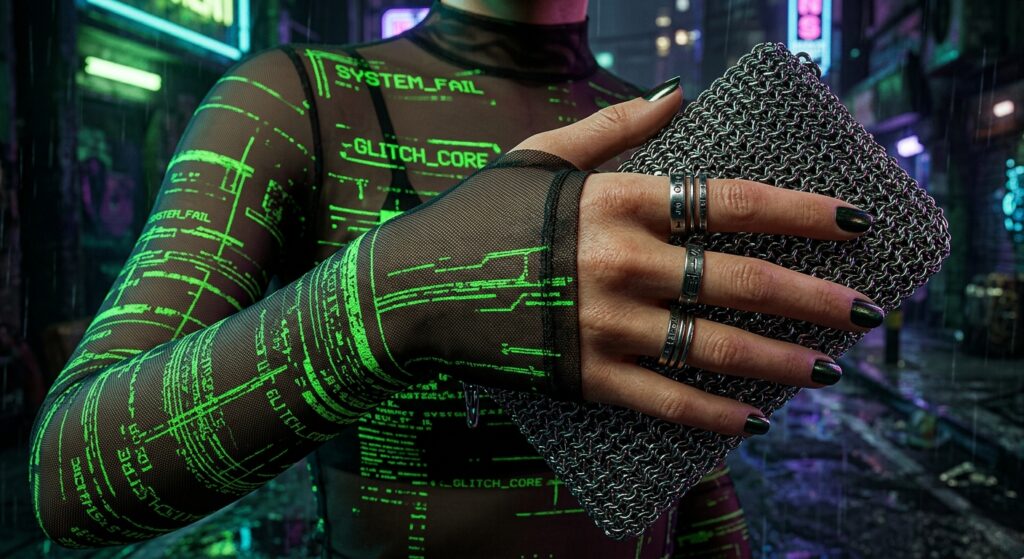
- The Thumbhole Cuffs. Here is where the garment reveals its intelligence. The sleeve does not end at the wrist. It extends, loops over the thumb, drapes across the metacarpals. The hand becomes a continuation of the torso. There is no gap, no vulnerable seam between “sleeve” and “skin.” This is antifragile design: the more you move, the more the fabric works with the hand rather than riding up, bunching, failing. A normal cuff is fragile. A thumbhole is a convex solution. You gain coverage, you gain warmth, you gain the look of a cybernetic graft, and you lose nothing.
- The Sheer Micro Mesh. Ultra-fine. Semi-transparent. You see the body beneath, but refracted, filtered through the weave like a face seen through a chain-link fence. It breathes. It drags slightly against the skin—a small tactile friction that reminds you the garment is there, that you are wearing something, that you have not simply been painted green. The mesh is the confession of emptiness of fabric: it is defined as much by what it removes (opacity, weight, bulk) as by what it adds.
- Long Sleeves. Full coverage, shoulder to fingertip. In a garment this sheer, the long sleeve is not modesty. It is architecture. It creates a continuous vertical line that makes the torso look longer, leaner, more deliberate.
- The Baby Tee Silhouette. Cropped. Fitted. Hits at or above the natural waist. The proportion is shrunken, almost aggressive in its smallness, like a ’90s Calvin Klein ad that got into a fight with a Blade Runner set designer and lost. It exposes the midriff or the waistband of whatever sits below. It says: the torso is finite. I will not waste fabric below the ribs.
Who Is This For?
Not for the passerby. Not for the person who buys a “festival outfit” from a fast-fashion rack on a Thursday and discards it in a landfill by Monday. Not for the “capsule wardrobe” theorist who owns eleven beige garments and calls it “intentional living.”
This is for the person with a naked conviction. The raver who has been to forty warehouses and can still feel the bass in her molars. The cyberpunk enthusiast who read Gibson at fourteen and never recovered. The alt-fashion devotee who builds a wardrobe the way a blacksmith builds a blade: slowly, deliberately, with heat and hammer and no apology.
It is for the content creator who actually creates rather than “curates.” For the editor who needs a garment that photographs like a small, contained explosion. For the non-binary dresser, the gender-fluid body, the person who looks at a mock neck and a thumbhole cuff and sees architecture rather than “menswear” or “womenswear.” The garment does not care about your pronouns. It cares about your proportions and your nerve.
It is for the person who walks into a room and would rather be noticed than comfortable, though the mesh, to its credit, offers both.
How to Style It (And How Not to Style It, Which Is More Important)
Styling is a problem of optionality. You want to maximize the number of outcomes in which you look like you belong in a Tarkovsky film and minimize the number in which you look like a “content creator” filming a “Get Ready With Me” in a rented Airbnb.
The barbell: go either extremely minimal or extremely maximal. The middle is where the Sensitive live.
Outerwear Options
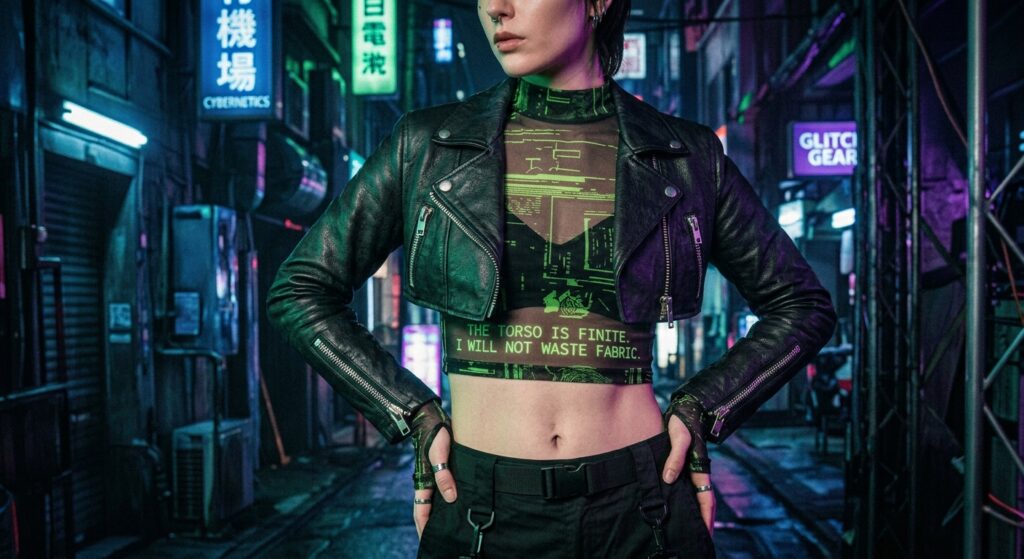
- The cropped black leather moto jacket. Obviously. The hardware—zippers, snaps, the small metal teeth of it—rhymes with the glitch print’s digital aggression. Keep it cropped. Do not, under any circumstances, wear a long duster over a baby tee unless you are six feet four and prepared to look like a background character in a Matrix sequel that went straight to DVD.
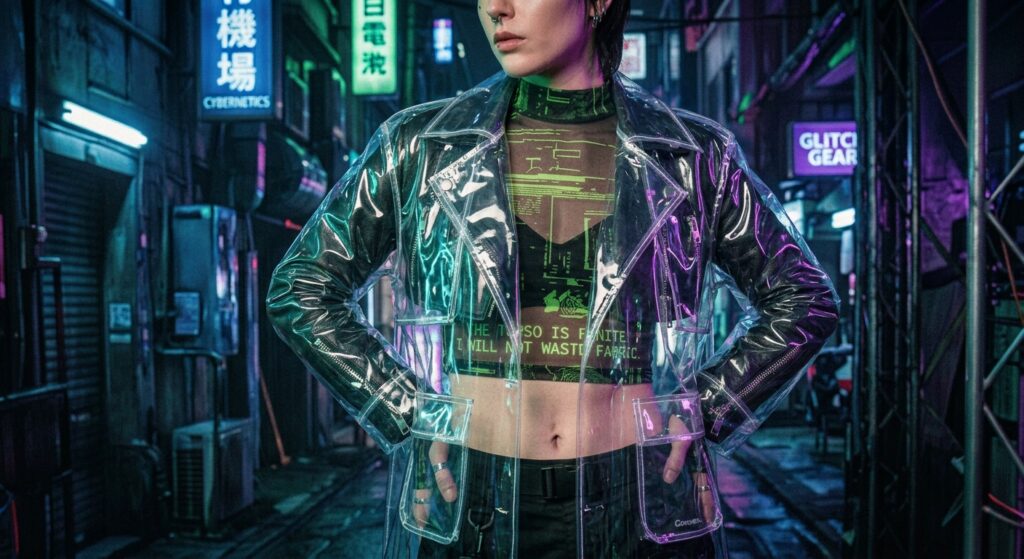
- The oversized transparent PVC trench. This is for the person who understands layering as optionality. You are adding a shell that changes nothing about the garment beneath but alters the context entirely. You can walk from a gallery opening into a rainstorm and the top survives. Convex.
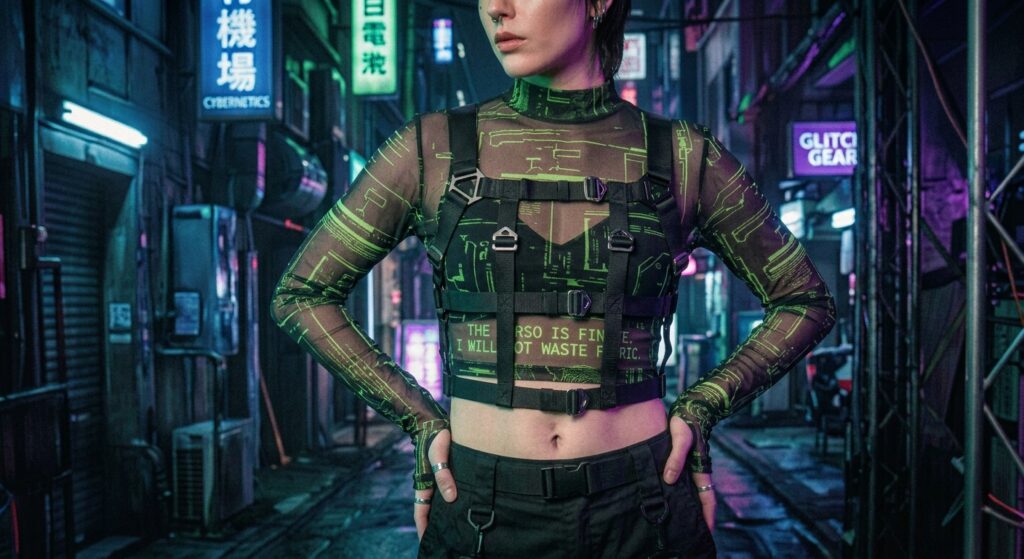
- A black utility harness vest worn directly over the mesh. Straps across the chest. No fabric, just geometry. The glitch print remains visible between the straps like a signal between bars of a cage. This is not a “fashion choice.” This is a statement of structural preference. You prefer the skeleton to the skin.
- The distressed denim trucker in acid-wash black, unbuttoned. For the day you want to look like you did not try. But you did try. You always try. The difference is whether the effort is visible, and visible effort is fragile.
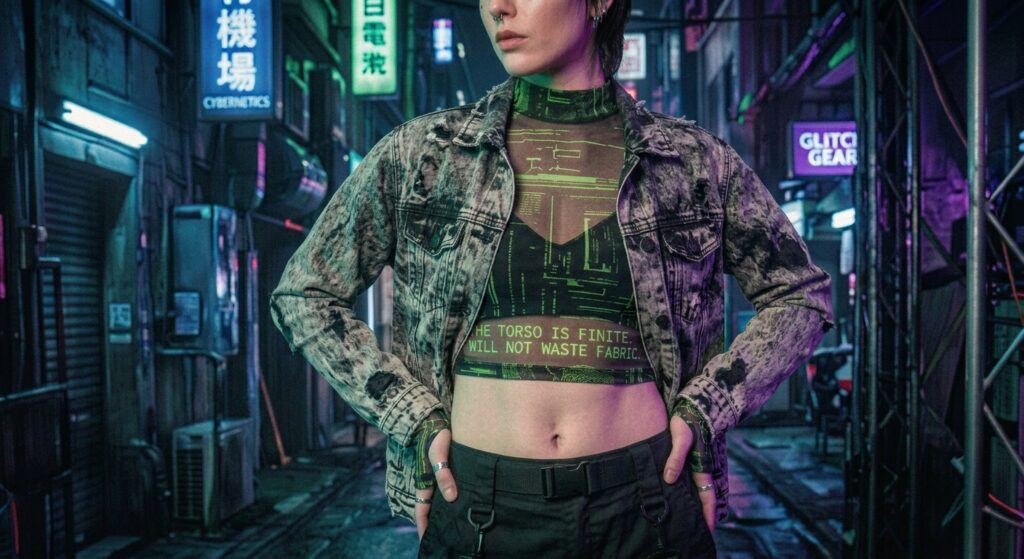
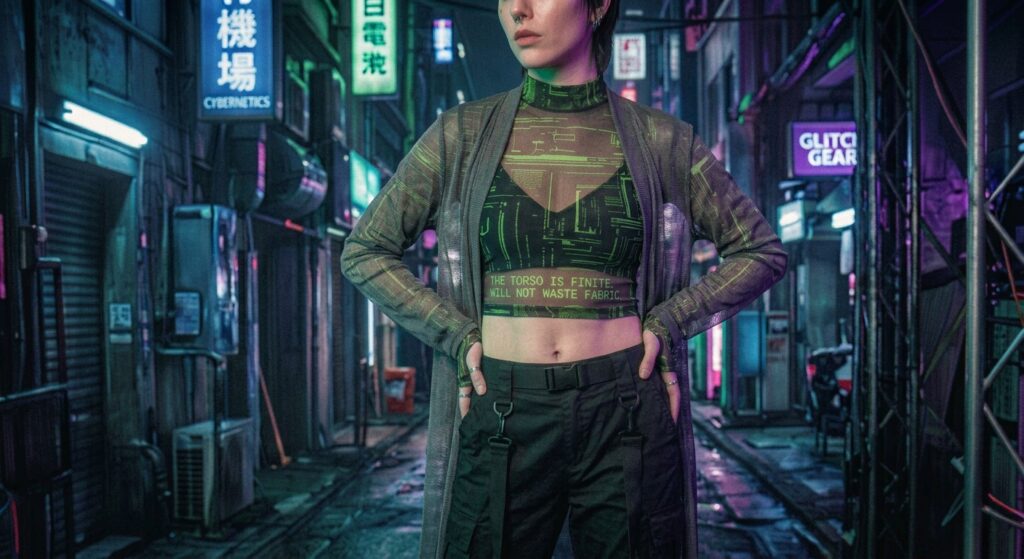
- The longline mesh duster in charcoal. Sheer over sheer. You become a palimpsest. Two layers of translucency, two different opacities, and the acid green glowing underneath both like a bioluminescent organism at the bottom of a trench. I have seen this in the wild, in Tokyo, on a woman who was smoking a cigarette and not looking at her phone, and I nearly walked into a bollard.
Footwear Options
- Chunky black platform combat boots. The sole is thick, industrial, ugly in the way that a Roman aqueduct is ugly: functional, heavy, indifferent to your feelings. It grounds the lightness of the mesh. Without it, you float away. With it, you are anchored to the earth while your torso broadcasts a corrupted signal. The asymmetry is the point.
- Neon-accented sneakers, white with green. Only if you are under twenty-five or possess the specific confidence of someone who has deadlifted twice their body weight and no longer requires validation from strangers. Otherwise, skip them. They tip the outfit toward “sporty” and away from “dystopian,” and dystopia is the entire point.
- Pointed-toe stiletto ankle boots in patent black. For the evening. For the person who wants the glitch print to read as dangerous rather than playful. The sharp toe is a blade. The patent leather reflects the acid green back at the viewer. You become a closed loop of menace.
- Knee-high lace-up boots in vegan leather. The Matrix reference is not subtle. I do not care. Subtlety is for people who cannot afford to be loud. The lacing creates a second layer of visual texture that competes productively with the mesh.
- LED-trimmed trainers. I include this only for completeness. If you wear these, you have crossed into a domain where I cannot help you. You are on your own. Godspeed.
Handbag Options
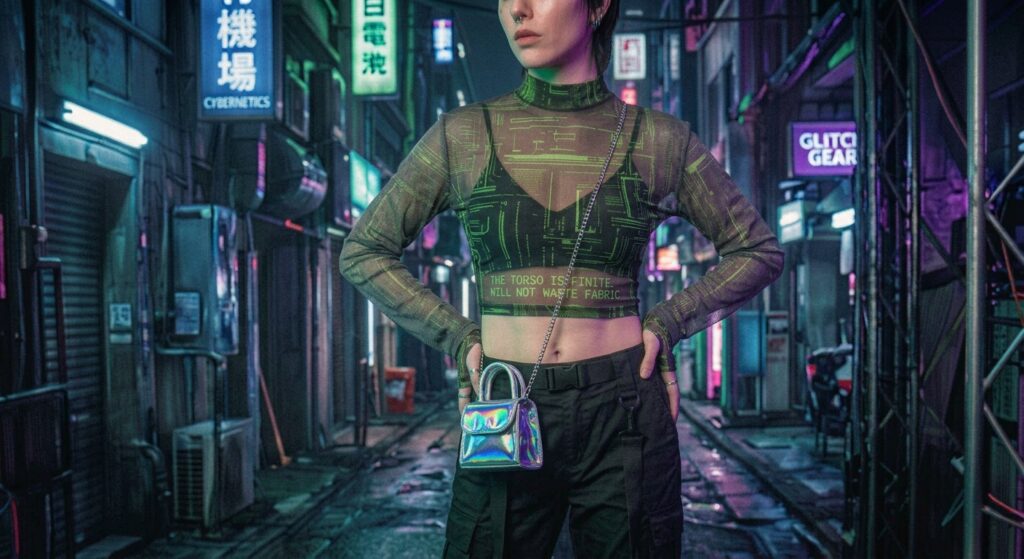
- The mini crossbody in holographic silver. Small. Reflective. It catches the same light the glitch print catches. It does not compete. It harmonizes. This is the Lindy choice: small bags have existed since someone first needed to carry three coins and a fig. They will outlive every “it bag” a luxury conglomerate manufactures to hit a quarterly earnings target.
- The black structured box bag with acid green hardware. A whisper. A nudge. The bag says, “I noticed the green. I will acknowledge it once, with a zipper pull, and then I will be silent.” Restraint. I respect restraint.
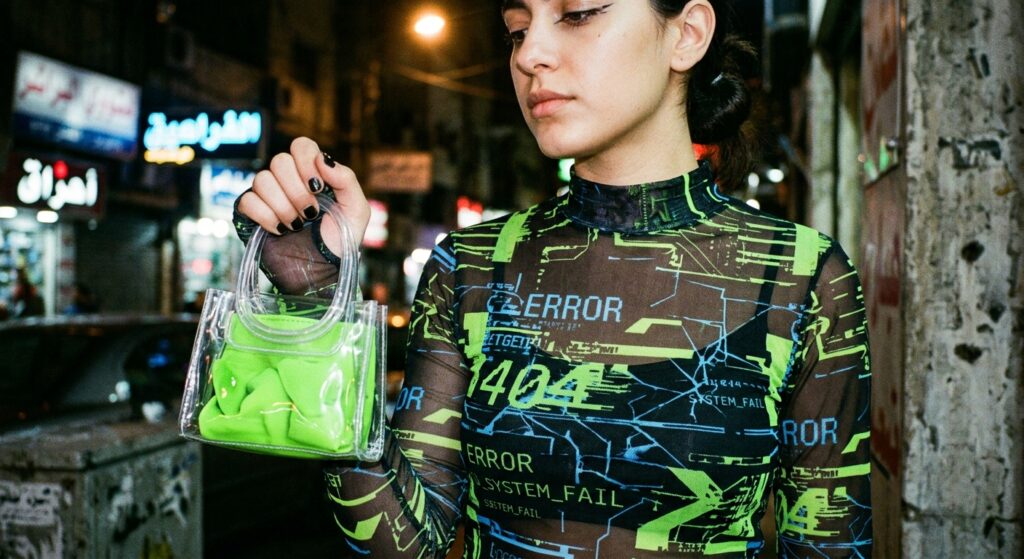
- The clear PVC micro bag with a green interior. Transparent exterior, colored interior. The logic of the mesh, miniaturized and carried in the hand. You see the shape of the contents but not the substance. Very Levantine. Very I will show you everything and tell you nothing.
- The tactical sling bag or chest rig in matte black. You are not carrying a handbag. You are carrying equipment. Phone, keys, a small flask of arak if you are sensible. The chest rig keeps the hands free. Free hands are antifragile hands. You can gesture, grip, defend, gesticulate wildly at a friend across a crowded room. A clutch makes you fragile. A rig makes you ready.
- The chainmail or metal mesh clutch. Texture echoes texture. The cold metal against the warm skin of the palm. It is armor you carry rather than wear. I approve.
Jewelry Options
- A chunky silver choker with geometric pendants, sitting just above the mock neck. Two parallel lines at the throat: fabric, then metal. The geometry of the pendants should be angular, not organic. No leaves. No flowers. Triangles. Hexagons. The shapes of a circuit board.
- Ear cuffs and industrial piercings in gunmetal or chrome. The ear is the only real estate left once the neck is occupied by the mock neck and the choker. Use it. Stack the metal. Make the ear look inhabited.

- Layered thin chains in mixed metals over the sheer mesh. They will catch the light differently at different angles. From the front, silver. From the side, gold. From behind, a tangle. The viewer gets a different necklace depending on where they stand. This is optionality in accessory form.

- Acid green resin or enamel rings. Small. One per hand, perhaps two. The color is already in the garment; the rings are an echo, not a repetition. The difference matters. An echo implies distance, reflection, a secondary source. A repetition implies a lack of imagination.
- LED or glow-in-the-dark bracelet stacks. For the rave. For the person who has decided, consciously and with full agency, to become a light source. I will not judge. I have worn worse.

Makeup Options
- Graphic neon liner. Acid green or electric lime. A sharp wing, or better, a geometric shape that does not resemble a wing at all—a parallelogram, a broken line, a deliberate glitch on the eyelid. The makeup should look like the print leaked from the shirt and colonized the face.

- Glitter-flecked, duochrome, holographic shadow applied with intentional imprecision. Smudged. Asymmetric. One eye more heavily done than the other. The “glitch” is not a mistake. The glitch is the point. A perfectly symmetrical smoky eye is fragile. An asymmetric, corrupted one is antifragile: it gets more interesting the more you look at it.
- Matte skin. Flawless. A single dot of neon pigment at the inner corner or below the lower lash line. The face is a blank screen. The green dot is a single dead pixel. You notice it. You cannot stop noticing it.
- The dark smoky eye in black and grey. Blade Runner. The replicant who does not know she is a replicant. This is for the person who wants the outfit to say cyberpunk and the face to say film noir. Two genres, one body. The tension is productive.

- Glossy, wet-look skin with bleached brows. The editorial approach. The face becomes neutral, almost absent, and the garment becomes the entire statement. This is via negativa applied to cosmetics: remove the brows, remove the matte, remove the person, and let the object speak.
Based on the Color Palette
The palette is acid green, black, silver, chrome, and the faint magenta and cyan that bleed out of the RGB glitch separation in the print. That is the universe. Everything outside that universe is distraction.
- The monochrome approach: all black beneath, beside, and around. The top is the single convex payoff. One explosion of color in a field of void. This is the barbell. You go extreme or you go home. Do not “tone it down” with a “nice camel trouser.” There is no camel in this universe. There is no beige. There is no oat milk.
- The complementary clash: hot magenta or electric violet in a single, small dose. A lip. A nail. The strap of a bag. This exploits the RGB separation already present in the glitch print. You are not introducing a new color. You are completing a signal that was already partially transmitted.
- The tonal approach: lime, chartreuse, mint, neon green in layers. Different saturations of the same frequency. This is for the person who wants to be seen from orbit. I respect the commitment. I would not do it myself. But I respect it.
- Metallic neutrals: silver, gunmetal, chrome. Cold. Reflective. They do not add color; they add surface. They bounce the acid green back at the viewer. The palette remains binary: green and metal. Everything else is excluded. Via negativa.
- What to avoid: earth tones. Pastels. Florals. Anything “boho.” Anything that a woman in a linen wide-brim hat would wear to a farmer’s market in upstate New York. These are fragile palettes. They will shatter against the acid green like a wine glass against a concrete wall. Do not mix them. You have been warned.
Narrowing Down by Weather and Season
- Spring. Mild. 55 to 70 degrees. The top is the hero. Nothing over it, or the cropped moto if the wind comes off the river. High-waisted black cargo pants or a vinyl mini. Chunky sneakers. The choker. No bag larger than a crossbody. You are mobile. You are unencumbered. You walk. You do not Uber. You walk, and the mesh catches the breeze, and the glitch print ripples, and you look like a transmission from a future that has not yet been approved by a committee.
- Summer. Hot. Above 75 degrees. The mesh is made for this. It is the entire reason the mesh exists. Wear it over a neon bralette or nothing. Low-rise baggy jeans or a micro mini. No outerwear. Open-toed platforms or barefoot-look lace-ups. Waterproof the liner. The micro crossbody. You will sweat. The mesh will not care. It will breathe. It will dry. It is antifragile in humidity. A cotton tee would be a wet rag by noon. The mesh will be fine by 2 p.m.
- Autumn. Cool. 50 to 65 degrees. Now you layer under. A black fitted bodysuit or opaque bralette beneath the mesh. The transparency remains, but the skin is veiled a second time. The leather jacket or the cropped bomber returns. Combat boots. A black beanie with a single acid green pin—small, Lindy, a small signal in the noise. The chest rig instead of the crossbody. The evenings are longer. You will be outside. You need your hands.
- Winter. Below 50 degrees. Here is the truth: this is not a winter garment. I will not pretend it is. But you are going to wear it anyway, because you are that person, and I respect the irrationality. So. A black thermal turtleneck underneath, the mock neck of the tee sitting over it like a collar on a priest. The PVC trench over everything. Fleece-lined boots. Fingerless gloves over the thumbhole cuffs because the mesh will not save your knuckles in a January wind. Swap the mesh accessories for solid leather. You are not styling anymore. You are surviving. And surviving in acid green is its own form of defiance. I applaud you.
Customer Feedback (Unfiltered, As It Should Be)
Customer Feedback (Unfiltered)
This is not a top you blend in with.
This is a top you boot up the room with.
And if that makes you fragile—if the thought of being seen, of being a single acid-green glitch in a grey world, makes your stomach tighten—then put on the beige. Put on the oat milk. Put on the capsule wardrobe and the linen hat and the “intentional living.”
I will be in the basement. In the fog. In the mesh.
The glitch will be glowing.